The Research

Bacopa Monnieri Research: What Does the Science Actually Show?

Bacopa monnieri has been studied in randomised, placebo-controlled human trials, particularly for memory and cognitive performance.

And when researchers look across the evidence, some of the most interesting findings appear around memory recall and retention — what happens to information after you’ve learned it.

The research isn’t perfect. Not every test finds a difference. And Bacopa isn’t something researchers studied for a quick, overnight effect. Most of the well-known human trials measured daily use over several weeks, often around 12 weeks.

So rather than promising you that Bacopa will “boost your brain”… let’s look at what researchers actually found.

See the research ↓
An amber supplement bottle labeled Koya Naturals Bacopa Monniери on a kitchen countertop, with a glass of water and two capsules nearby in a softly lit kitchen setting.

Learning something is one thing. Remembering it later is another.

You read a name. You can repeat it five seconds later. Easy. But tomorrow? Is it still there?

That’s the difference between taking information in… and holding on to it. And it’s where some of the most interesting Bacopa monnieri research begins.

Does Bacopa monnieri actually work?

There isn’t a truthful yes-or-no answer that applies to every person, every Bacopa extract and every measure of brain function. The research is more specific than that.

Human trials have studied Bacopa monnieri across areas including:

  • Memory recall
  • Retention of newly learned information
  • Verbal learning
  • Attention
  • Processing speed
  • Working memory

And the results aren’t equal across all of them. Some measures have shown statistically significant differences compared with placebo. Others haven’t.

So we don’t think the right question is: “Does Bacopa boost your brain?” A better question is: “What exactly did the Bacopa studies find?”

Here’s the evidence.

Bacopa & memory · Roodenrys 2002

Bacopa monnieri and memory: the Roodenrys study

76 adults · 12 weeks · Bacopa vs placebo
  • Randomised
  • Double-blind
  • Placebo-controlled
  • Conducted over approximately 12 weeks

One of the best-known Bacopa memory studies was published in Neuropsychopharmacology in 2002. Researchers studied 76 healthy adults aged 40 to 65.

And the result gets interesting when you separate learning from remembering. Researchers found a significant effect on the retention of newly learned information. But the rate at which participants learned the information? That was unaffected.

Follow-up analysis suggested the difference came from a reduced rate of forgetting newly acquired information. Put simply: the interesting finding wasn’t “they learned it faster.” It was what happened to the information after they learned it.

Roodenrys et al. (2002), Neuropsychopharmacology
Read the published study →
Bacopa monnieri and memory: the Roodenrys study

What about delayed recall?

Another important Bacopa clinical trial looked at healthy adults over 55.

Delayed recall · Morgan & Stevens 2010

Delayed recall in adults over 55

98 started · 81 completed · 300 mg/day · 12 weeks
  • Verbal learning
  • Memory acquisition
  • Delayed recall

98 adults started the study; 81 completed it. Participants were randomly given either placebo or 300 mg/day of a Bacopa extract for 12 weeks. Neither the participants nor the researchers administering the tests knew who was receiving which.

Statistically significant differences between the groups were reported for measures including verbal learning, memory acquisition and delayed recall. The delayed-recall result was reported at p = 0.001.

Other measures did not produce statistically significant differences between the groups. And participants taking Bacopa reported more gastrointestinal side effects. That’s important too — because we’re not here to show you only the parts that make Bacopa look good.

Morgan & Stevens (2010), Journal of Alternative and Complementary Medicine
Read the published study →
Delayed recall in adults over 55

One positive study isn’t enough.

Anyone can find one study and build a sales pitch around it. We’d rather look at the pattern. That’s where systematic reviews and meta-analyses become useful. Instead of asking “did one Bacopa study find something?”, they ask a harder question: “what happens when we look across multiple trials?”

Systematic review · Pase 2012

What did the Bacopa systematic review find?

6 studies · 12 weeks each · 300–450 mg/day

Researchers reviewed randomised, controlled human trials studying Bacopa monnieri and cognition. Six studies met their final criteria. Every study ran for 12 weeks, at doses ranging from 300–450 mg per day, and all six included memory testing.

Across those studies, Bacopa performed better on 9 of 17 tests of memory free recall. The evidence across other areas of cognition was much more limited.

That’s worth reading twice. The review didn’t conclude “Bacopa makes every part of your brain work better.” It found something narrower: evidence around memory free recall, and much less evidence for many other cognitive abilities. That’s why you’ll see us talk so much about memory and recall rather than making giant claims about “brain power.”

Pase et al. (2012), Journal of Alternative and Complementary Medicine
Read the systematic review →
What did the Bacopa systematic review find?
Meta-analysis · Kongkeaw 2014

What did the Bacopa meta-analysis find?

9 trials · 518 participants (437 in the analysis)

A later meta-analysis looked across randomised controlled Bacopa trials. 9 trials met the inclusion criteria, together involving 518 participants; of those, 437 eligible participants were included in the statistical meta-analysis.

The researchers reported effects on certain cognitive measures, including measures relating to attention and memory. Again, this doesn’t mean every cognitive test improved, that every participant experienced a noticeable difference, or that every Bacopa extract on the market is identical to the extracts researchers studied.

It tells us something more useful: Bacopa has been tested across multiple controlled human trials, and there are specific areas of cognition where researchers have reported meaningful signals.

Kongkeaw et al. (2014), Journal of Ethnopharmacology
Read the meta-analysis →
What did the Bacopa meta-analysis find?
Reviewing the human trials — randomised, placebo-controlled evidence.

Bacopa research at a glance

518
Adults across the trials in the 2014 meta-analysis
Published research
9
Randomised trials met the inclusion criteria
Double-blind, placebo
300mg
The daily dose the studies used (up to 450 mg)
Standardised for bacosides
8–12
Weeks of daily use the trials measured
Nothing works overnight

We won’t promise you miracles. The research is good, not magic — but it’s real, and it’s why we made this.

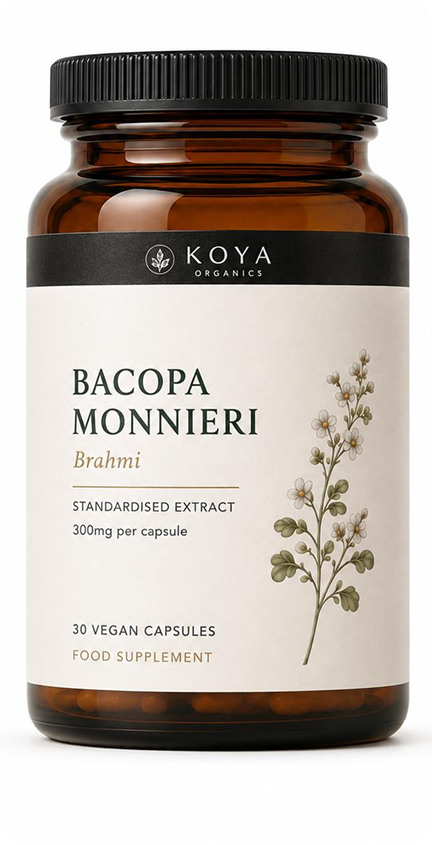
Bacopa monnieri (Brahmi) — the single botanical the research studied.

How long does Bacopa monnieri take to work?

This might be one of the biggest misunderstandings about Bacopa. The major chronic trials didn’t test an overnight effect — they measured what happened after weeks of consistent use. In the Pase systematic review, every included trial lasted 12 weeks.

So Bacopa is very different from something like caffeine. There isn’t supposed to be a big jolt. No sudden rush. No “wow, I can feel my brain working” moment five minutes after taking it. The research question is much slower: what changes after taking Bacopa consistently over time?

Which is why judging Bacopa after a couple of days tells you very little about the research described on this page.

What dose of Bacopa was used in clinical trials?

There isn’t one universal “clinical dose” that applies to every Bacopa extract. Different researchers have used different preparations. In the six trials included in the Pase systematic review, doses ranged from 300–450 mg of Bacopa extract per day.

And this brings us to something supplement labels often don’t explain: 300 mg of one Bacopa extract isn’t automatically the same as 300 mg of another. Why? Because Bacopa is a plant. And plants vary.

Why does Bacopa standardisation matter?

Two bottles can both say “Bacopa monnieri — 300 mg,” and that doesn’t necessarily mean the contents are identical. Where the plant was grown, when it was harvested, which part was used, how it was extracted, and how the finished extract was standardised can all matter.

Bacopa contains naturally occurring compounds called bacosides. These compounds are commonly used when standardising Bacopa extracts. So when you’re comparing Bacopa supplements, don’t look at the big milligram number alone — look at what those milligrams actually represent.

Where does Koya Bacopa fit?

We made Koya for people who would rather know what’s in their supplement than stare at a giant list of “brain ingredients.” So we kept it simple: one botanical, one clear daily amount, standardised Bacopa monnieri. No caffeine. No hidden proprietary brain blend. No throwing ten ingredients into a capsule just because the label looks more impressive.

And no pretending our bottle was used in studies when it wasn’t. The published research tested specific Bacopa extracts; Koya wasn’t the intervention used in those trials. That’s important. What we can tell you is exactly what we’ve chosen to put in ours — and why we’ve chosen to keep it simple.

Koya — one standardised botanical, one clear daily dose.

What doesn’t the Bacopa research show?

This is where supplement pages usually get very quiet. We won’t.

It doesn’t show that Bacopa makes everyone smarter.

Cognition isn’t one thing. Memory, attention, reasoning, learning and processing are different abilities, and the research does not show the same result across all of them.

It doesn’t show that Bacopa works overnight.

Many of the better-known chronic trials measured supplementation over approximately 12 weeks. That’s very different from taking a capsule this morning and expecting something dramatic by lunch.

It doesn’t show that every person will notice a difference.

Studies measure differences between groups. They don’t guarantee an individual result. People vary.

It doesn’t show that every Bacopa extract is identical.

Researchers used particular preparations and standardised extracts. You can’t automatically take the result from one extract and claim every Bacopa product will behave identically.

It doesn’t make Bacopa a treatment for Alzheimer’s, dementia or memory loss.

Koya is a food supplement, not a medicine. If you’re concerned about changes in your memory or cognition, speak with your GP or another appropriate healthcare professional.

So… is Bacopa monnieri effective?

Here’s the fairest answer we can give you. Bacopa monnieri has a genuine body of human research behind it. Randomised, placebo-controlled trials have studied it. Systematic reviews have examined those trials. A meta-analysis has pooled results from them. And some of the most interesting findings concern memory recall, retention and specific measures of cognitive performance.

At the same time: not every study finds the same thing. Not every cognitive measure changes. Different extracts have been used. And research findings don’t guarantee what one person will experience.

That’s not as exciting as promising you a “limitless brain.” We think it’s a lot more useful.

Straight Answers

Bacopa monnieri research: your questions answered

What is Bacopa monnieri?

Bacopa monnieri is a small creeping plant with a long history of use in Ayurveda. Modern researchers have studied Bacopa extracts in human trials across memory and other areas of cognitive performance.

Read: What Is Bacopa Monnieri? →

What is Bacopa monnieri studied for?

Human clinical trials have studied Bacopa in relation to memory, recall, learning, attention and other measures of cognitive performance. Systematic research suggests the evidence is stronger for some memory measures than for broad improvements across every area of cognition.

Does Bacopa monnieri help with memory?

Human trials and systematic reviews have investigated Bacopa for several memory measures. Findings have included differences in retention, delayed recall and memory free recall, although results vary by study, test and extract.

Does Bacopa help you learn faster?

Not necessarily. In the Roodenrys study, the rate at which participants learned new information was unaffected. The significant finding instead concerned retention of newly learned information, with analysis suggesting a reduced rate of forgetting.

How long was Bacopa used in the studies?

Many well-known chronic Bacopa studies lasted around 12 weeks. All six trials included in the Pase systematic review lasted 12 weeks.

How much Bacopa was used in clinical trials?

The six studies included in the Pase systematic review used Bacopa extracts at 300–450 mg per day. Different studies have used different extracts, so the milligram amount should not be considered in isolation.

How does Bacopa make you feel?

Bacopa isn’t caffeine and shouldn’t be confused with a stimulant. Clinical studies generally assess changes using cognitive tests rather than relying simply on whether participants “feel” something immediately. So the research doesn’t support thinking about Bacopa as an instant buzz or mental jolt.

Does Bacopa have side effects?

Bacopa has been generally tolerated in clinical research, although gastrointestinal effects have been reported in some studies. If you take medication, have a medical condition, are pregnant or breastfeeding, or are unsure whether a supplement is appropriate for you, speak to your doctor or pharmacist before using it.

Bacopa vs Ashwagandha: what’s the difference?

They’re different plants with different bodies of research. Bacopa monnieri research has included memory, recall, learning, attention and other cognitive measures. Ashwagandha research has investigated a different range of outcomes and uses. So asking “which one is better?” misses something important — better for what? The answer depends on why you’re considering either plant in the first place.

Bacopa vs Ginkgo biloba: what’s the difference?

Bacopa and Ginkgo are different botanical ingredients and shouldn’t be treated as interchangeable “brain herbs.” Both have been investigated in cognitive research, but the evidence base, extracts, study populations and outcomes differ. If you’re comparing them, look past the words “brain supplement” and look at what researchers actually tested.

Why we chose Bacopa

We could have made another “brain blend.” A little of this, a sprinkle of that, a long ingredient list, a huge name on the front — and no easy way of knowing which ingredient you’re actually taking enough of.

We chose a different route. One botanical with a real body of human research. A clearly stated amount. A standardised extract. And enough transparency for you to look at the research and make your own mind up.

Because you don’t need another supplement company telling you something is incredible. You need enough information to decide for yourself.

Read the research. Then decide.

You now know what Bacopa has been studied for. You know what some of the major trials found. You know what they didn’t find. You know the doses researchers studied. And you know those studies generally measured weeks of consistent use — not an overnight transformation.

So if you’ve read this far and Bacopa still makes sense for you… here’s how we’ve chosen to make ours.

Koya Organics Bacopa Monnieri

  • Standardised Bacopa monnieri
  • Clearly stated daily amount
  • No caffeine
  • No proprietary brain blend
  • Quality and testing information available
  • 90-day money-back guarantee

One plant. No wild promises.

Bacopa Monnieri Research & References

Roodenrys S, Booth D, Bulzomi S, et al. (2002). Chronic Effects of Brahmi (Bacopa monnieri) on Human Memory. Neuropsychopharmacology, 27.

Morgan A, Stevens J. (2010). Does Bacopa monnieri Improve Memory Performance in Older Persons? Results of a Randomized, Placebo-Controlled, Double-Blind Trial. Journal of Alternative and Complementary Medicine.

Pase MP, Kean J, Sarris J, et al. (2012). The Cognitive-Enhancing Effects of Bacopa monnieri: A Systematic Review of Randomized, Controlled Human Clinical Trials. Journal of Alternative and Complementary Medicine, 18(7), 647–652.

Kongkeaw C, Dilokthornsakul P, Thanarangsarit P, et al. (2014). Meta-analysis of randomized controlled trials on cognitive effects of Bacopa monnieri extract. Journal of Ethnopharmacology, 151(1), 528–535.

Research reviewed and page updated: September 2026